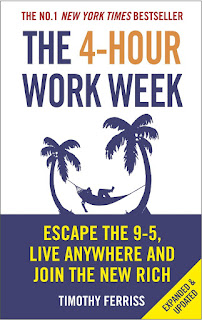
I am glad that this is the first book I picked to read in this new year.
This book provides interesting concepts, actual life hacks that can help you
increase productivity, motivate you to work on the things that matter by making
each minute of yours count. I wouldn’t say that this book is only for entrepreneurs.
This is for anyone and everyone who is serious about changing his/her current working
lifestyle and way of living. And the pandemic just made some of the situations
easy.
Timothy Ferriss often referred as Tim Ferriss, the author of the book mentions
about the New Rich (NR) community, a fast-growing subculture who has mastered
the art of mobility to create a luxurious life for themselves instead of living
with a retirement plan every day. He uses the examples of NRs throughout the
book to draw the comparison between habits of NRs and others.
What distinguishes this book from any other productivity improvement/ lifestyle
improvement book is that Tim has provided lots of practical tips, many useful
web links in the book (informative for US folks) rather than just talking about
the subject. I have only come across few books where authors have actually shared
links that they practically use ( one other book is Game Changers by Dave
Asprey )
This book offers a lot of tips. My top five key take-aways are as follows:
1.
Use of Parkinson’s Law:
Use this law to accomplish more
in less time. Shorten the schedules, the meeting durations, deadlines for
project so that one has full focus on the work and does not end up
procrastinating. I am sure many of us can think of such situations where we
would have applied this in our work, in our college – like annual project being
completed in two days etc. The fundamental is simple – if we are crunched for
time, we are often forced to use it efficiently.
2.
Apply Pareto’s Principle:
This is my saver and now I
take a meaner look at all the work activities I am ‘supposed’ to do. Pareto’s
principle states that roughly 80% of the effect comes from 20% of the causes.
Tim advises to use this statistical technique in selecting our tasks that have
a significant impact overall. I strongly believe that applying Pareto’s
principle, be it in our business or personal lives, we can streamline our focus
on important few and make our lives much simpler.
3.
Use of Automation and Delegation:
In the world of AI, automation and outsourcing,
this advice certainly rings the bell. The process looks like this. If you don’t
need to do a task and does not have any meaningful value, eliminate it. If it
can’t be eliminated but can be automated, automate it. If it can’t be
automated, look forward to delegate it (outsource it).
Tim shares examples from
his own life what he has done, how he uses automated response on mails,
automated mailing list software etc. and outsourced some of his work to an
agency in India. (On a lighter note, I am just wondering whom we shall (Indians)
outsource our work to?). I am sure, like Tim and other NRs, if we look at our
activities, there is plenty of room for elimination, automation, delegation etc.
4.
Take Mini Retirements:
Tim emphasizes on taking mini
retirements throughout your life instead of planning to retire at the end of
your working life. And one doesn’t need to be rich to go on big adventures that
we often fancy about. Tim has again shared a lot of informational resources on
how to plan mini retirements including some interesting travel websites too. I
don’t think this trend has picked up yet, but with the changing workstyles and
new millennials joining the workforce, global organizations will soon be open
to this idea of mini retirements.
But here’s a catch: You can’t take a mini
retirement, sit at home and do nothing. You need to find something interesting
which you can talk about, after you’re back from the break. And if one is
smart, one can leverage that experience to not just stand out from rest of the
folks but use it effectively to crack the interview.
5.
Be Minimalist:
Tim urges everyone to follow this advice
at least for travelling purposes. This gives you mobility and flexibility to
change your plans rather than be tied to the schedule. He also mentions about
BIT – Buy it There. If you are going to a city which has a decent living, why
do you need to pack moisturizers, shampoos, toothpaste etc. Buy it there.
Simple.
There are tons of other lessons one may take- related
to boosting confidence, best time to make cold calls, why should one be business
owner and not business runner etc. Tim has dedicated the last section of his
book to the best of his blogs collection, which is a treat.
However, there are
some points on which I disagree with him when it comes to crossing work ethics.
But I guess, the way the pandemic has changed the workstyles, I don’t need to
worry about crossing it. People don’t have to lie or use technology hacks or
trick their boss to go for staycation. Companies are now open to work from home
style of working. People have already started doing staycation, some European
countries have started giving short term visas for people to come and work, understand
the culture before deciding to move or not. All we can do is take the best advantage
of time.
Overall, this book offers some good practical ways
to improve productivity so that we can ensure that we give our quality time to
the people we care about and do things that we are passionate about. I would suggest
this book to anyone who is willing to take a hard look at his/ her life and is
open to take some bold steps for change. No one has ever won by simply doing
nothing.
Feel free to leave your comments whether you found this book review useful? In case, you have read the book, don't forget to share your thoughts. Happy reading!